For centuries, the remarkable navigational abilities of homing pigeons have baffled scientists and enthusiasts alike. These feathery messengers can find their way home across hundreds of miles of unfamiliar terrain, a capability that persists even when visual landmarks are obscured. Recent breakthroughs in biophysics and quantum biology now suggest their secret lies in an extraordinary quantum compass hidden within their beaks.
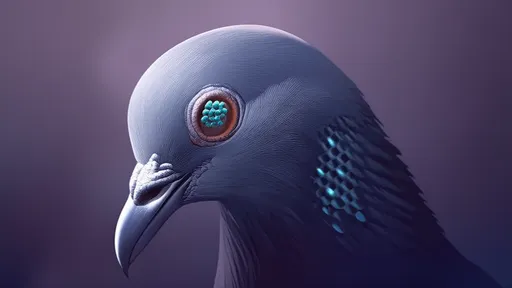
The discovery centers around clusters of magnetite crystals found in the upper beak area of pigeons. These iron-rich minerals align with Earth's magnetic field, creating what researchers believe to be nature's most sophisticated biological navigation system. Unlike human-made compasses that simply point north, the avian system appears to provide pigeons with a three-dimensional magnetic map of their position relative to home.
What makes this biological compass extraordinary is its suspected quantum mechanical underpinnings. Scientists propose that these magnetite crystals don't just passively respond to magnetic fields but may exploit quantum coherence - the same phenomenon that powers cutting-edge quantum computing research. This would allow pigeons to detect not just the direction but the intensity of magnetic fields with extraordinary sensitivity.
Professor Henrik Mouritsen, a leading researcher in animal navigation at the University of Oldenburg, explains: "The precision with which migratory birds and homing pigeons can detect magnetic fields suggests there's more at work than simple iron crystals. We're increasingly convinced that quantum effects play a crucial role in how these signals are processed at the neural level."
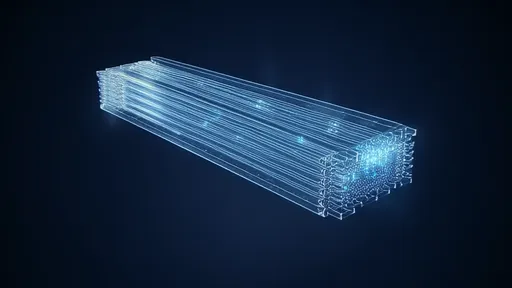
The magnetite clusters in pigeon beaks are arranged in a highly organized three-dimensional structure, with crystal sizes ranging from 1 to 5 micrometers. Electron microscopy reveals these crystals are often perfectly shaped and aligned, suggesting biological control over their formation that goes far beyond random mineralization.
Recent experiments have shown that disrupting these magnetite clusters causes pigeons to lose their navigational abilities, while leaving other cognitive functions intact. When researchers attached small magnets near the birds' beaks or applied localized magnetic pulses, the pigeons became disoriented in overcast conditions where they couldn't rely on visual cues.
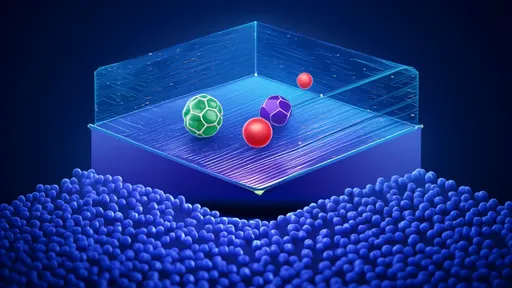
The quantum compass hypothesis gained significant traction when physicists recognized similarities between the magnetite structures in birds and synthetic quantum systems designed to detect extremely weak magnetic fields. In both cases, the systems appear to rely on quantum spin states that are sensitive to external magnetic fields while being protected from rapid decoherence by the surrounding environment.
Dr. Jessica Boles, a quantum physicist who has studied biological navigation systems, notes: "Nature seems to have solved problems that quantum engineers are still struggling with - maintaining quantum states in warm, wet, noisy environments. If we can understand how biological systems achieve this, it could revolutionize our approach to quantum sensing technologies."
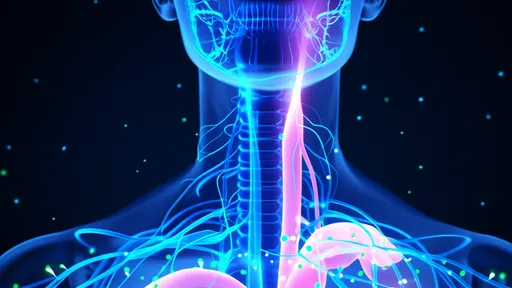
The exact neural pathways connecting the magnetite sensors to the pigeon's brain remain partially mapped. Current evidence suggests signals from the beak travel via the trigeminal nerve to specialized regions of the brain that integrate magnetic information with visual and olfactory cues. This integration creates a multimodal cognitive map that guides navigation.
Interestingly, the sensitivity of this system appears to vary with life stage and experience. Young pigeons on their first migrations show less precision than experienced adults, suggesting that learning plays a role in calibrating the quantum compass. This combination of hardwired quantum sensing and learned refinement makes the system both robust and adaptable.
Seasonal changes in magnetite crystal organization have also been observed, hinting at possible biological mechanisms for adjusting sensitivity based on migratory needs. During peak migration seasons, the crystals appear more densely packed and better aligned, while in stationary periods the organization becomes less pronounced.
The implications of this research extend far beyond understanding avian navigation. Military and civilian researchers are intensely interested in developing quantum-inspired navigation systems that don't rely on GPS satellites. Such systems would be immune to jamming or spoofing and could work anywhere on Earth or even in space where magnetic fields are present.
Medical researchers are also exploring whether similar magnetite-based systems might exist in humans. While humans don't show conscious magnetic sensing abilities, trace amounts of magnetite have been found in human brain tissue, leaving open questions about potential subconscious effects of magnetic fields on human physiology and behavior.
Conservation biologists warn that human-generated electromagnetic noise might be interfering with these delicate quantum biological systems. Some studies suggest that radio frequency pollution in urban areas could be disrupting migratory patterns, potentially contributing to declines in certain bird populations.
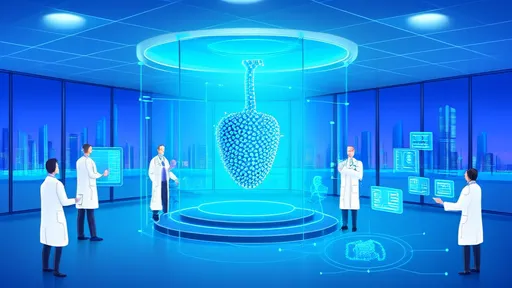
As research continues, scientists are developing increasingly sophisticated tools to study these quantum biological phenomena without disrupting them. New types of quantum microscopes and non-invasive magnetic sensors are allowing researchers to observe the systems in action, revealing details about how quantum states are maintained and how information is transmitted to the brain.
The humble homing pigeon, once valued as a messenger and now often overlooked, continues to deliver important messages - not written on paper, but encoded in the quantum properties of magnetite crystals in its beak. As we decode these messages, we may unlock secrets that transform fields from neuroscience to quantum computing, all while gaining deeper appreciation for nature's ingenious solutions to complex problems.
What makes this discovery particularly exciting is that it represents one of the clearest examples of quantum effects operating at biological scales and temperatures. For decades, physicists assumed quantum phenomena would be too fragile to play significant roles in warm, wet biological systems. The pigeon's quantum compass proves otherwise, suggesting we may find quantum biology more widespread in nature than previously imagined.
Future research directions include attempts to artificially recreate the magnetite structures found in pigeons, studies of how quantum information is processed in avian brains, and investigations into whether similar systems exist in other migratory species. Each of these avenues could yield breakthroughs with applications across multiple scientific and technological domains.
For now, the pigeon's beak remains one of nature's most astonishing examples of quantum engineering - a biological wonder that has guided these birds across continents for millennia and may now guide human technology into new frontiers.
By /Jul 18, 2025
By /Jul 18, 2025

By /Jul 18, 2025
By /Jul 18, 2025
By /Jul 18, 2025
By /Jul 18, 2025
By /Jul 18, 2025
By /Jul 18, 2025
By /Jul 18, 2025
By /Jul 18, 2025

By /Jul 18, 2025

By /Jul 18, 2025

By /Jul 18, 2025
By /Jul 18, 2025

By /Jul 18, 2025
By /Jul 18, 2025
By /Jul 18, 2025
By /Jul 18, 2025
