The vast oceanic deserts, covering nearly 40% of the Earth's surface, have long been considered biological wastelands. These nutrient-poor regions, known as subtropical gyres, are the marine equivalent of arid landscapes—sparse, lifeless, and seemingly incapable of supporting vibrant ecosystems. Yet, beneath their shimmering blue surfaces lies an untapped potential that could revolutionize our approach to carbon sequestration and climate change mitigation.
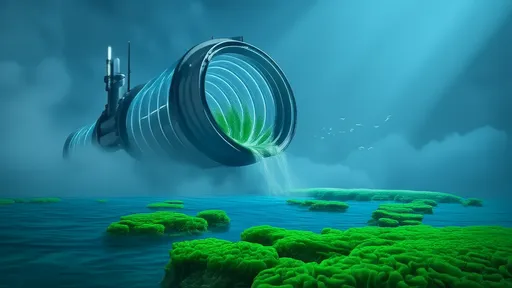
Recent breakthroughs in marine geoengineering have unveiled a startling possibility: the artificial greening of oceanic deserts through controlled upwelling systems. Scientists are now experimenting with large-scale interventions to transform these barren waters into thriving algal carbon sinks. The implications are profound—not just for marine ecology, but for humanity's struggle against rising atmospheric CO₂ levels.
The Science Behind Artificial Upwelling
Natural upwelling occurs when deep, nutrient-rich waters rise to the surface, typically along coastlines where winds push surface waters offshore. This phenomenon creates some of the ocean's most productive ecosystems, supporting everything from microscopic plankton to commercial fisheries. The new artificial systems replicate this process in open ocean deserts using wave-powered pumps or compressed air systems to bring deep water to the surface.
These nutrient-laden waters act as fertilizer for phytoplankton blooms. Early trials have demonstrated that a single upwelling device can stimulate algal growth across hundreds of square kilometers. The algae absorb substantial amounts of carbon dioxide through photosynthesis, with a portion sinking to the deep ocean as "marine snow"—a natural carbon sequestration process that could lock away CO₂ for centuries.
Engineering Challenges and Solutions
Creating reliable upwelling systems in the open ocean presents formidable engineering hurdles. The devices must withstand extreme weather, corrosive saltwater, and the immense pressures of the deep ocean while operating with minimal energy input. Several prototype designs have emerged, including wave-driven "pump trees" that resemble underwater kelp forests and compressed air "bubble curtains" that create continuous upward water movement.
Perhaps the most promising development comes from hybrid systems that combine artificial upwelling with offshore renewable energy platforms. Floating wind turbines or wave energy converters could power more sophisticated pumping mechanisms while providing stable platforms for monitoring equipment. This synergy between energy production and carbon sequestration could make the technology economically viable at scale.
Ecological Considerations
While the carbon sequestration potential excites researchers, the ecological impacts demand careful study. Large-scale algal blooms could alter marine food webs, potentially benefiting some species while disadvantaging others. There are concerns about creating dead zones if blooms decompose en masse, though proponents argue that controlled upwelling would prevent such scenarios by maintaining balanced nutrient ratios.
The selection of algal species presents another critical consideration. Some researchers advocate for promoting diatoms—silica-shelled phytoplankton that sink rapidly—while others explore genetically modified strains optimized for carbon capture. The debate continues about whether to encourage natural community assemblages or guide the ecosystem toward specific, high-performance species.
Carbon Accounting Complexities
Quantifying the actual carbon sequestration remains challenging. While satellite imagery can track surface chlorophyll concentrations indicating algal blooms, determining how much carbon ultimately reaches the deep ocean requires sophisticated sampling. Sediment traps, underwater drones, and isotopic tracing methods are being deployed to measure carbon flux with greater accuracy.
Another complication arises from potential "leakage"—the phenomenon where stimulated algal growth in one area might simply draw nutrients away from other regions, yielding no net gain. Comprehensive modeling suggests this effect may be minimal in oceanic deserts where nutrient transport occurs over vast timescales, but the scientific community continues to refine these assessments.
Policy and Governance Dimensions
The legal framework for large-scale ocean interventions remains murky. International waters fall under complex treaties that weren't designed with geoengineering in mind. Some nations view artificial upwelling as a form of marine resource development, while others categorize it as scientific research or environmental modification.
Pioneering projects have navigated these waters by establishing transparent monitoring regimes and engaging stakeholders early. The Pacific Ocean Upwelling Project, for instance, created an independent scientific oversight board and real-time data sharing protocols to build trust and facilitate international cooperation.
Economic Viability and Scaling Potential
Current cost projections suggest artificial upwelling could sequester carbon at competitive prices compared to other negative emission technologies—potentially below $50 per ton once deployed at scale. The added benefits of enhanced fisheries and possible spin-off products from algal biomass could improve the economic equation further.
Investment is flowing into the sector from both private carbon offset markets and government climate initiatives. Several carbon credit certification bodies are developing methodologies to verify oceanic carbon removal, though standards remain in flux. The coming years will likely see the first commercial-scale deployments as the technology matures.
The Road Ahead
As prototypes transition to pilot projects and eventually to widespread implementation, the greening of ocean deserts through artificial upwelling stands poised to become a major frontier in climate intervention. Unlike many speculative geoengineering proposals, this approach works with natural marine processes rather than against them.
The ultimate promise lies not in replacing emissions reductions but in complementing them—creating a powerful tool to remove legacy carbon while restoring productivity to marine ecosystems that have been nutrient-starved for millennia. As one researcher put it, "We're not trying to play God with the oceans; we're just giving them a helping hand to do what they've done naturally for eons, but now at the scale our climate crisis demands."

By /Jul 18, 2025

By /Jul 18, 2025

By /Jul 18, 2025

By /Jul 18, 2025

By /Jul 18, 2025

By /Jul 18, 2025

By /Jul 18, 2025

By /Jul 18, 2025

By /Jul 18, 2025

By /Jul 18, 2025

By /Jul 18, 2025

By /Jul 18, 2025

By /Jul 18, 2025

By /Jul 18, 2025

By /Jul 18, 2025

By /Jul 18, 2025
By /Jul 18, 2025

By /Jul 18, 2025
