The hum of a mosquito is one of the most universally recognized—and universally loathed—sounds in nature. Yet, not all mosquitoes buzz equally. Some species have evolved near-silent flight, a trait that has long puzzled scientists. Recent breakthroughs in fluid dynamics and bioacoustics are finally revealing the secrets behind this stealthy adaptation.
For decades, researchers assumed that mosquito wings produced sound primarily through the vibration of their wingbeats, much like other flying insects. However, a closer examination of their wing mechanics has uncovered a far more complex interplay of aerodynamics and structural resonance. Unlike bees or flies, mosquitoes employ a unique combination of high-frequency wing strokes and asymmetrical motion to minimize noise while maintaining lift.
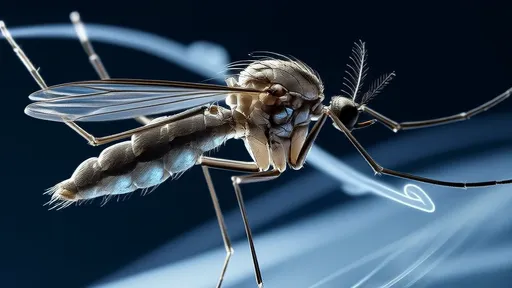
The key lies in their wing geometry and movement patterns. Mosquito wings are exceptionally long and narrow relative to their body size, allowing for a reduced acoustic signature. High-speed videography has shown that their wings don’t simply flap up and down but rotate subtly during each stroke, creating vortices that enhance lift without the turbulent airflow typically associated with audible wing noise. This rotational motion, combined with an ultra-fast beat frequency of up to 800 Hz, generates lift efficiently while scattering sound waves in a way that cancels out much of the perceptible noise.
Further studies using computational fluid dynamics (CFD) models have demonstrated how these tiny insects exploit the principles of aeroacoustics—the study of sound generated by air movement. The leading edge of a mosquito’s wing slices through the air with minimal resistance, while the trailing edge manipulates airflow to prevent the formation of loud, chaotic eddies. This precision engineering at the microscopic level allows mosquitoes to remain acoustically covert, even when flying mere centimeters from their prey.
But why evolve silence at all? For female mosquitoes—the ones that bite—stealth is a survival strategy. Their primary targets, humans and other animals, are highly sensitive to the whine of approaching insects. A silent approach reduces the chance of detection, enabling them to feed undetected. This evolutionary arms race between mosquito stealth and host vigilance has driven the refinement of their near-noiseless flight over millions of years.
Interestingly, not all mosquitoes are equally quiet. Species that feed on less alert hosts, such as birds or reptiles, often exhibit louder flight patterns. This variation supports the theory that acoustic stealth is an adaptive trait shaped by the hearing sensitivity of their preferred prey. Laboratory experiments comparing different species have confirmed that those targeting humans consistently produce less sound, with some registering at barely 20 decibels—close to the threshold of human hearing in a quiet room.
The implications of this research extend beyond entomology. Engineers are already looking to mosquito-inspired designs for quieter drones and micro-aerial vehicles (MAVs). The principles of their wing motion could revolutionize propulsion systems in applications where noise reduction is critical, such as surveillance or search-and-rescue operations. Biomimicry of mosquito wings might even lead to advances in wind turbine efficiency, where minimizing acoustic pollution is a growing priority.
Yet, many questions remain. How exactly do mosquitoes coordinate their wing muscles to achieve such precise control? What role does the flexibility of their wing membranes play in sound suppression? Ongoing research involving laser vibrometry and 3D-printed robotic wing models aims to unravel these mysteries. Each discovery not only deepens our understanding of insect biomechanics but also highlights the elegance of evolution’s solutions to complex problems.
For now, the next time you don’t hear a mosquito approaching, you’ll know to appreciate—or resent—the sophisticated fluid dynamics at work. Their silence isn’t luck; it’s the result of millennia of evolutionary fine-tuning, turning them into some of nature’s most efficient and elusive aviators.

By /Jul 18, 2025

By /Jul 18, 2025

By /Jul 18, 2025

By /Jul 18, 2025

By /Jul 18, 2025

By /Jul 18, 2025

By /Jul 18, 2025

By /Jul 18, 2025

By /Jul 18, 2025

By /Jul 18, 2025

By /Jul 18, 2025

By /Jul 18, 2025

By /Jul 18, 2025
By /Jul 18, 2025

By /Jul 18, 2025
By /Jul 18, 2025

By /Jul 18, 2025

By /Jul 18, 2025
